What Is G-LAY Graphene?
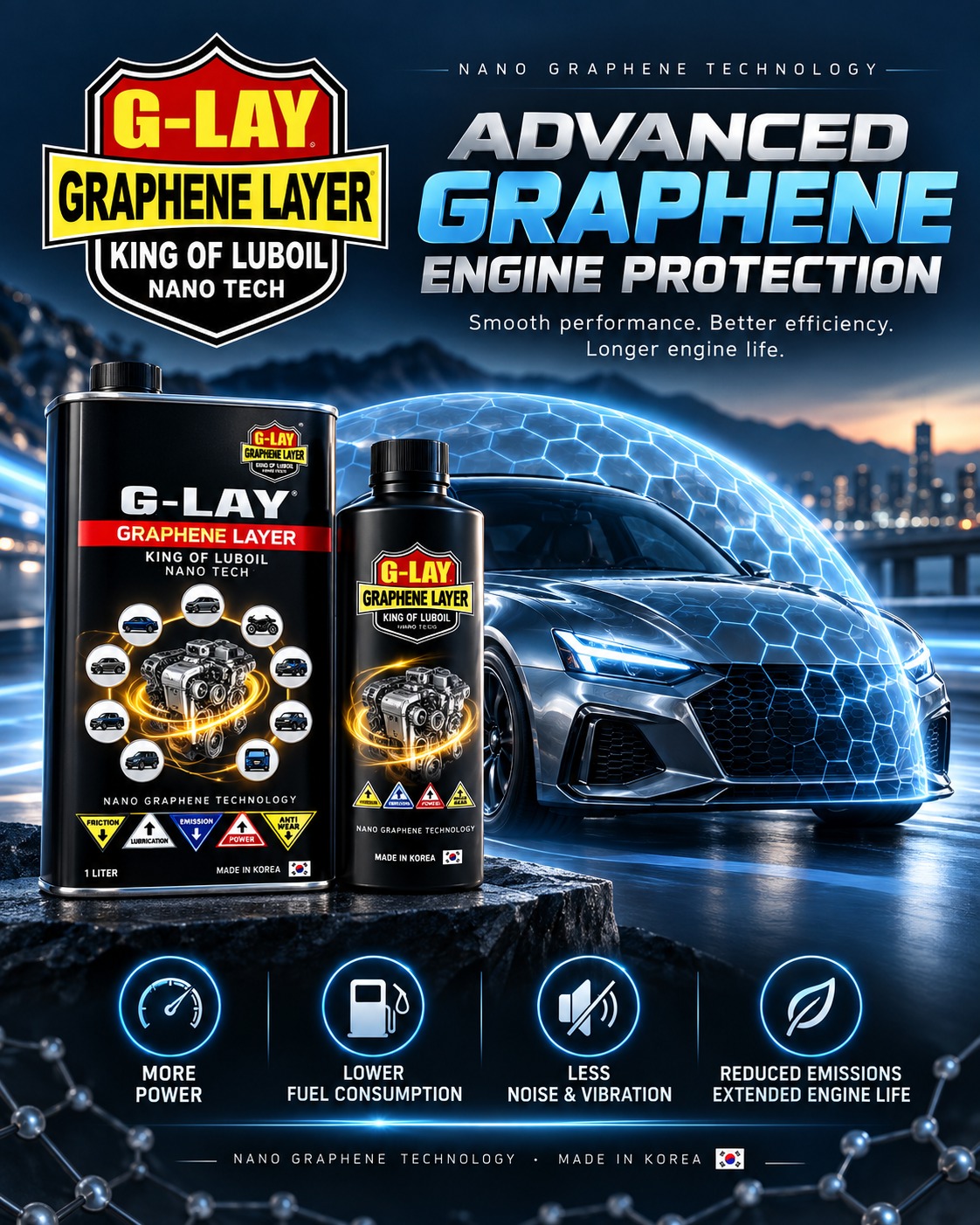
G-LAY is a perfect nano-cermet: 20-nanometre platinum-coated zirconium powder, emulsified in mineral oil as reduced graphene oxide (rGO) just 0.25 nm thick and 50 nm wide. Added to your engine oil, it is incomparable against conventional additives, MoS₂, Teflon, ceramic, silica or boron.
Graphene is the "wonder material" of the next generation, up to 200 times stronger than steel, yet ultra-thin and flexible. Inside your engine, it does extraordinary work.
Four Things Happening Inside Your Engine
Self-Restoring Coat
Cracked metal carries high electric potential. Charged graphene migrates selectively to those worn surfaces and bonds, filling the crevices.
Platinum Hardness
Platinum is 20× harder and 6× smoother than steel, creating a hard, slick layer across all friction surfaces and moving parts.
Thermal Barrier
The zirconium coating acts as a thermal barrier inside the cylinder, preventing heat loss and protecting components.
Sealing Function
By sealing worn surfaces it blocks unburned-emission leakage past the piston, raising pressure, output and fuel efficiency.
G-LAY vs. Ordinary Additives
| Property | Existing Additives | G-LAY Premium (rGO) |
|---|---|---|
| Heat stability | Poor, breaks down in high heat | Excellent |
| Surface bond | Weak, flaky | Strong, chemical bond |
| Durability | Low | High,20,000–30,000 km |
| Particle base | MoS₂, Teflon, ceramic, silica, boron | Nano reduced graphene oxide |
| Oil filter risk | Micron particles may clog filter | Nano-scale, filter safe |
| Environmental impact | Some harmful (e.g. MoS₂) | Eco-friendly, reduces CO₂ |
Independently Lab-Tested
Engine Output
Dynamometer testing showed increased power output after a single G-LAY treatment.Power up to +42%
Emission Reduction
Emission testing recorded major drops in harmful exhaust output under idle conditions.Emission up to −83%
Fuel Efficiency
Steady-speed road testing confirmed measurable fuel-efficiency gains.Fuel saving 5–17%
Noise & Vibration
dB testing over 60 minutes showed quieter, smoother running engines.Noise −35 to −56%
Oil Life & Acidity
Total Acid Value and viscosity tests showed longer, healthier oil life.Tested to 359,000+ km
Abrasion Loss
Metallic abrasion particles (Fe, Si, Mn) in the oil were significantly reduced.Verified by KIMM
Testing conducted by the Korea Institute of Machinery & Materials (KIMM) and the Korea Automobile Technical Institute, 2019.
How to Apply G-LAY
Shake Well
Shake the G-LAY pouch thoroughly, around 50 times, so the graphene is evenly dispersed.
Pour In
Open the oil filler cap and slowly inject G-LAY into the engine oil. Best after a fresh oil change.
Run It
Close the cap, then idle for 20 minutes or drive about 30 km to let the coating form.
Re-apply
No re-dosing needed. Re-treat after about 30,000 km, or 3× normal oil life. Top up oil if the level drops.